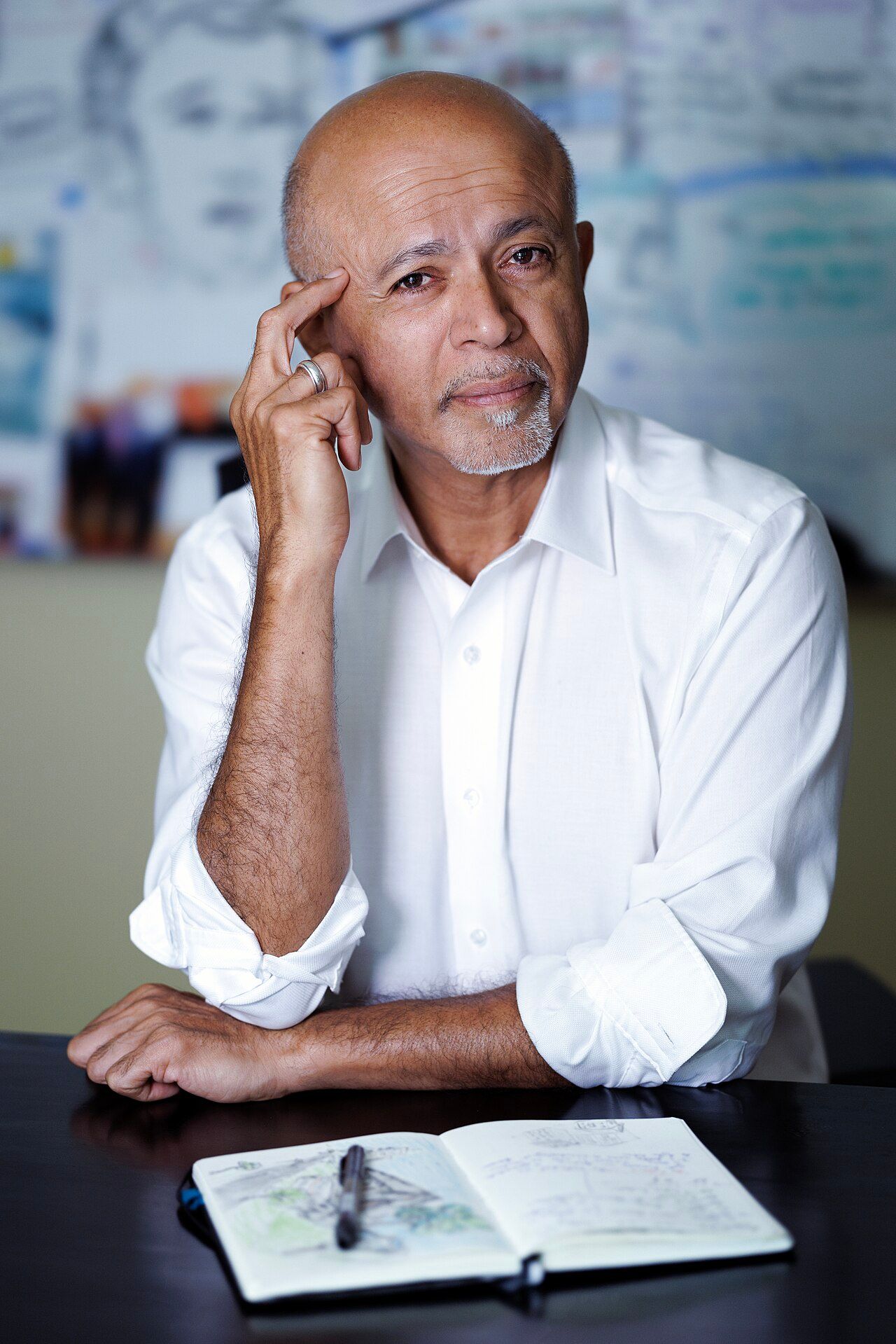
From the public record. Written from the published sources listed at the end. RICH DOCTOR has not interviewed Dr Abraham Verghese; every quotation comes from a cited source.
Their path
1955
Born in Addis Ababa to Indian parents from Kerala
1974
Medical studies in Ethiopia interrupted by revolution
1983
Internal medicine residency, East Tennessee State University
1991
MFA in fiction, Iowa Writers' Workshop
2007
Joins Stanford
2009
Publishes Cutting for Stone
2023
Publishes The Covenant of Water
Abraham Verghese’s medical education was interrupted by a revolution. In 1974, when Emperor Haile Selassie was deposed, the medical student born in Addis Ababa to teachers from Kerala had to leave Ethiopia.4 He joined his parents in the United States and spent about a year working in a hospital.
“I began to work as a hospital orderly or nursing assistant,” he said in 2023, “which I look back on now as the best training I ever had.”3
The first career
He finished his medical degree at Madras Medical College, trained in internal medicine at East Tennessee State University from 1983, and did a fellowship in infectious diseases at Boston University.14 In 1985 he returned to Johnson City, Tennessee, as an assistant professor.4
He spent about five years caring for patients with HIV there.3 The experience left him with something a research paper could not hold. “I became a writer,” he said, “to tell the story of H.I.V. in that small town.”3
The decision
To do it properly, he did something few established doctors do. He cashed in his retirement savings, gave up a tenured position and moved to Iowa.3 In 1991 he graduated with a master’s in fiction from the Iowa Writers’ Workshop.1
He did not leave medicine. He became chief of infectious diseases at Texas Tech in El Paso, later founded a centre for medical humanities in San Antonio, and joined Stanford in 2007.42 Since 2017 he has directed Stanford’s PRESENCE programme.1
The books came alongside: My Own Country (1994), about those years in Tennessee; The Tennis Partner (1998); and two novels, Cutting for Stone (2009) and The Covenant of Water (2023).1 He received the National Humanities Medal from President Obama in 2016.1
What the path shows
Many doctors have a second passion that they keep in a drawer. Verghese took his out and gave it the same discipline he gave medicine: formal training, real risk, years of work. Then he brought it back into the clinic.
The lesson is not that every doctor should write a novel. It is that a second calling can enrich the first, if it is taken seriously rather than treated as a hobby to be squeezed into the gaps.
Pieces bylined to The Editors are written and edited by the RICH DOCTOR editorial team and represent the publication's own view. Every claim is sourced, and corrections are made openly.
Standing interests: The publication has no commercial relationships with any company mentioned in our independent journalism. Partner content and affiliate links are always labelled.
Judged on one question: does it return more time than it takes? The kinds of apps worth keeping, the settings that matter more than any app, and how to tell the difference.