Case HistoryWorking life
Abhay and Rani Bang: research done with a village
Two doctors with Johns Hopkins degrees moved to one of India's poorest districts. Their village trial changed how newborns are cared for at home.
By The Editors
Independent
From the public record. Written from the published sources listed at the end. RICH DOCTOR has not interviewed Drs Abhay Bang and Rani Bang; every quotation comes from a cited source.
Their path
- 1972
- Both complete MBBS, Nagpur University
- 1977
- Marry; begin work at Chetana Vikas, Wardha
- 1984
- Both complete MPH, Johns Hopkins
- 1985
- SEARCH registered; work in Gadchiroli begins 1986
- 1993
- Home-based newborn care trial begins
- 1999
- Trial published in The Lancet
- 2018
- Padma Shri, awarded jointly
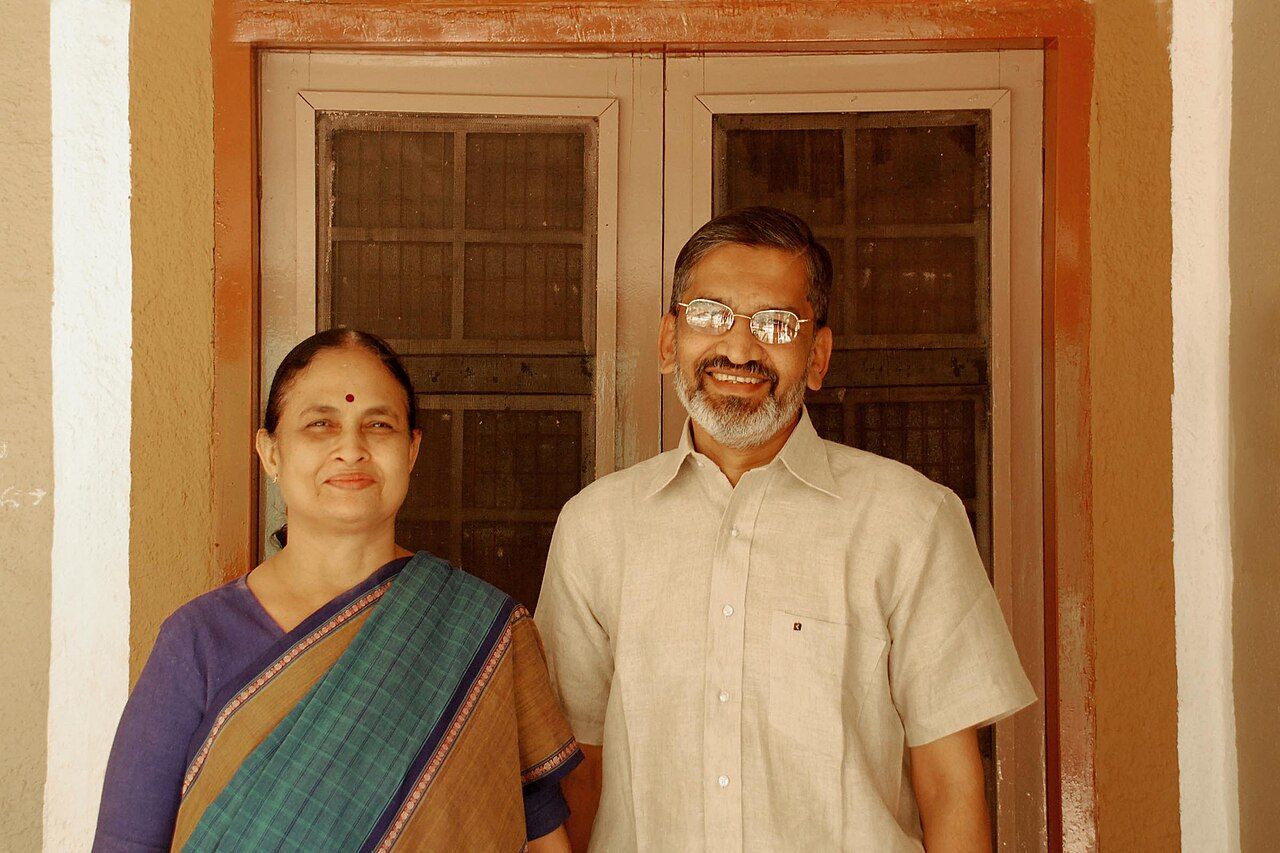

In 1984, two Indian doctors finished master’s degrees in public health at Johns Hopkins. The conventional next step would have been a research career in a university or an international agency. Abhay and Rani Bang went to Gadchiroli, a largely tribal district in eastern Maharashtra, instead.24
Two doctors, one decision
Both had qualified in medicine at Nagpur University in 1972 and gone on to MDs there, he in medicine and she in obstetrics and gynaecology.25 Abhay grew up at Gandhi’s Sevagram ashram, where he went to school.4 At Johns Hopkins, Rani graduated as a gold medallist.5
They registered their organisation, SEARCH, in 1985 and moved its work to Gadchiroli in 1986.1 Abhay Bang later described the thinking behind it with a contrast: “Research is normally done sitting in air-conditioned, ivory towers,” he said. “At Shodhgram (Search village), we do research with people.”4
The trial
Their best-known work began in 1993. In 39 villages, trained village health workers visited newborns at home to give basic care and treat illness. Another 47 villages served as a comparison.3
The results, published in The Lancet in 1999, were striking. In the intervention villages, neonatal mortality fell from 62.0 to 25.5 deaths per 1,000 live births, a fall of 59%. In the comparison villages it rose slightly, from 57.7 to 59.6.3
The approach did not stay in Gadchiroli. It was replicated by other organisations and by the Indian Council of Medical Research, accepted by WHO and UNICEF in 2009, and adopted by the Government of India through its village health workers.1
In 2018 the Bangs were awarded the Padma Shri jointly.6
What the path shows
It is tempting to read this as a story of sacrifice. It reads better as a story of rigour. The Bangs did not leave research behind when they left the cities; they took it with them, and their village trial was published in The Lancet.
For a young doctor weighing a rural posting as a career interruption, theirs is a useful counter-example. The work that changed national policy was done far from any teaching hospital, by people who chose the place deliberately and stayed.
Written by
The Editors
RICH DOCTOR editorial team
Pieces bylined to The Editors are written and edited by the RICH DOCTOR editorial team and represent the publication's own view. Every claim is sourced, and corrections are made openly.